2026 Winter Institute
Environmental Change and Society:
Focusing on the Management and its Future of Agricultural Reservoirs in Japan


Worldmaking for Relational Continuity:
Narratives across Life, Death, and Future Generations


Forests as regulators of water and carbon:
Can management enhance these ecosystem functions?

Transnational Forum on Sustainability
10:00~10:30 Opening Ceremony
University Sustainability Governance
-
Speaker

Konstantinos Kontis
Mechan Chair of Engineering
Dean of Global Engagement
University of Glasgow -
Speaker

Johan Lauwereyns
Professor
Faculty of Arts and Science
Senior Vice President for International Affairs
Kyushu University -
Speaker

Hsiang-Lin Liu
Professor
Department of Physics
Director
Environmental and Public Safety Center, NTNU -
Speaker

Eugene Chien
Executive Advisor
National Climate Change Committee,
Office of the President
Chairman and President
Taiwan Institute of Sustainable Energy (TAISE)
Ambassador-at-Large for Climate and Sustainability
R. O. C.
Opening Remarks

Climate Risk and Rural Revitalisation
-
Speaker

Fabrice Renaud
Head of The School of Social & Environmental Sustainability
University of Glasgow -
Speaker

Noriko Sato
Professor
Department of Agro-environmental Sciences,
Kyushu University -
Moderator
Wei-Ta Fang
Distinguished Professor
Graduate Institute of Sustainability Management and Environmental Education
Associate Dean of College of Science, NTNU
Reducing climate-related risks in rural areas:
how can nature-based solutions help?



AI & Sustainable Education
10:20~12:10 Teaching Sustainably in the Age of AI
13:20~15:10 Educating sustainability change-makers


Sustainable Tourism
10:20~12:10The Challenge of Achieving Net Zero in the Scottish Context
13:20~15:10Tackling Overtourism in Scotland (with Initiatives)


Closing Remarks

Final Exam
Questions & Answer Key: Download
| Item | Percentage | Details |
|---|---|---|
| Attendances and Participation | 60% | There will be a total of 15 lectures (30 hours in total). Each absence will result in a 4% deduction. |
| End-of-term exam | 40% | Written examination |
| Required and Recommended Texts/Readings with References | (Presentation slides) | |
WHY | Why should I join this winter course?
This is the longest winter break ever. Why should I attend this course or join the lectures?
There are three main reasons:
-
Earn 2 credits in 10 days
Make use of the winter intensive course to quickly complete general education credits. -
Sustainability is a topic that everyone must pay attention to
For example:
- Mudflow disasters caused by continuous rainfall in Guangfu Township, Hualien
- Large-scale wildfires occurring in the United States and Europe
-
An opportunity to meet international scholars and improve your English proviciency
Professors from the UK and Japan will teach in person, providing a great opportunity to practice English and gain international perspectives.
WHAT | What attractive content does this course offer?
What are the key features of this course?
-
International co-teaching
Multiple professors from the University of Glasgow (UK) and Kyushu University (Japan) will jointly teach, offering first-hand international perspectives on sustainability. -
Cross-campus learning
Open to NTNU, NTU, and NTUST students, as well as students from universities and colleges nationwide as well as members of the public. All are welcome to study sustainability together. -
Interdisciplinary topics
The program covers a wide range of sustainability topics, including climate and environmental change, rural revitalization, water resources, sustainable education, sustainable design, and sustainable tourism. -
Fully English-taught
Aligning with the government's Bilingual 2030 policy, the course provides a fully immersive English learning environment and an excellent opportunity to enhance global competence.
WHO & HOW | Who can join and how to participate?
How can I register or join the courses?
| WHO | Course Type | How to Join |
|---|---|---|
| Students needing academic credit | Credit-bearing course (Lectures on General Education, 114-2) |
|
| Students, NTNU faculty/staff, and the general public | Lecture series | Online registration;Participants who attend at least 20 hours (2/3 of the course) will receive a certificate of completion for NTNU’s Sustainability Micro Program. |
| Note: Members of the public requiring credits or inter-university students applying for credits should refer to the information below. | ||
Is this a winter course? When is the course selection period?
Yes, this is an intensive winter course (2025/1/19–1/29). Please refer to the course selection schedule below.
| First-round course selection | Second-round course selection | Intercollegiate Course Selection and the General Public (Credit Seeking) |
Course Add/Drop period | |
|---|---|---|---|---|
| Period | 2026/1/6~1/9 | 2026/2/3~2/5 | 2026/2/9~3/9 | 2026/2/23~3/8 |
| NTNU students | Online Course Add/Drop | Students who registered in the first round but did not attend may drop the course online | X |
|
| NTU & NTUST Students | X | X | X | Students who attended the class but have not yet selected the course must use an authorization code to add the course online |
| Students from other universities | X | X | Apply with paper forms to the Office of Academic Affairs | X |
| General Public (Credit Seeking) |
X | X | Apply with paper forms to the Office of Academic Affairs | X |
| General Public (Certificate Only) |
X | X | X | X |
How can I make sure I receive credits for this course? (Important! Must Read!)
- The credits for this Lectures on General Education will be counted under the 114-2 semester, although all classes will be completed during the winter break.
-
For NTNU students: Please log in to the course selection system and add this course during the
first-round course selection period (January 6–9, 2026). If you miss the first round, you may still
add the course with an authorization code during the add/drop period (February 23–March 8, 2026).
-
For NTU and NTUST students: You must use an authorization code to add the course during the
add/drop period (February 23–March 8, 2026)
Please note: At NTU and NTUST, this course is not counted as an inter-university General Education course; it will be listed as an free elective credit. Whether it can be counted toward graduation credit requirements depends on your department’s regulations. Students from partner universities are strongly advised to confirm the relevant policies with their department in advance. -
How authorization codes will be sent:
Authorization codes will be sent before the add/drop period to the email address you provided in the event registration system.
Please make sure you have completed registration through the official event sign-up page and that the email address you entered can successfully receive messages.
(Do not use Hotmail, MSN, Livemail, or Outlook accounts, as they may fail to receive system-generated notifications and authorization codes.)
WHEN & WHERE | Course time and location
Is this course offered during the winter break? What is the course schedule?
Yes. This is an intensive winter course held from January 20 to January 29 with a total of 30 teaching hours. The final assessment will take place on January 30 (no classes on that day). This is an official course—students who pass will receive credits and a certificate. You do not need to arrive at 8:00 a.m. Class hours are: Morning: 10:20–12:10 | Afternoon: 13:20–15:10. For detailed scheduling, please refer to the course timetable on the website.
Where is the class held?
|
Classes for January 20~22 and January 26~30 take place at Cheng 101 Classroom, College of Liberal Arts Building, NTNU Main Campus. 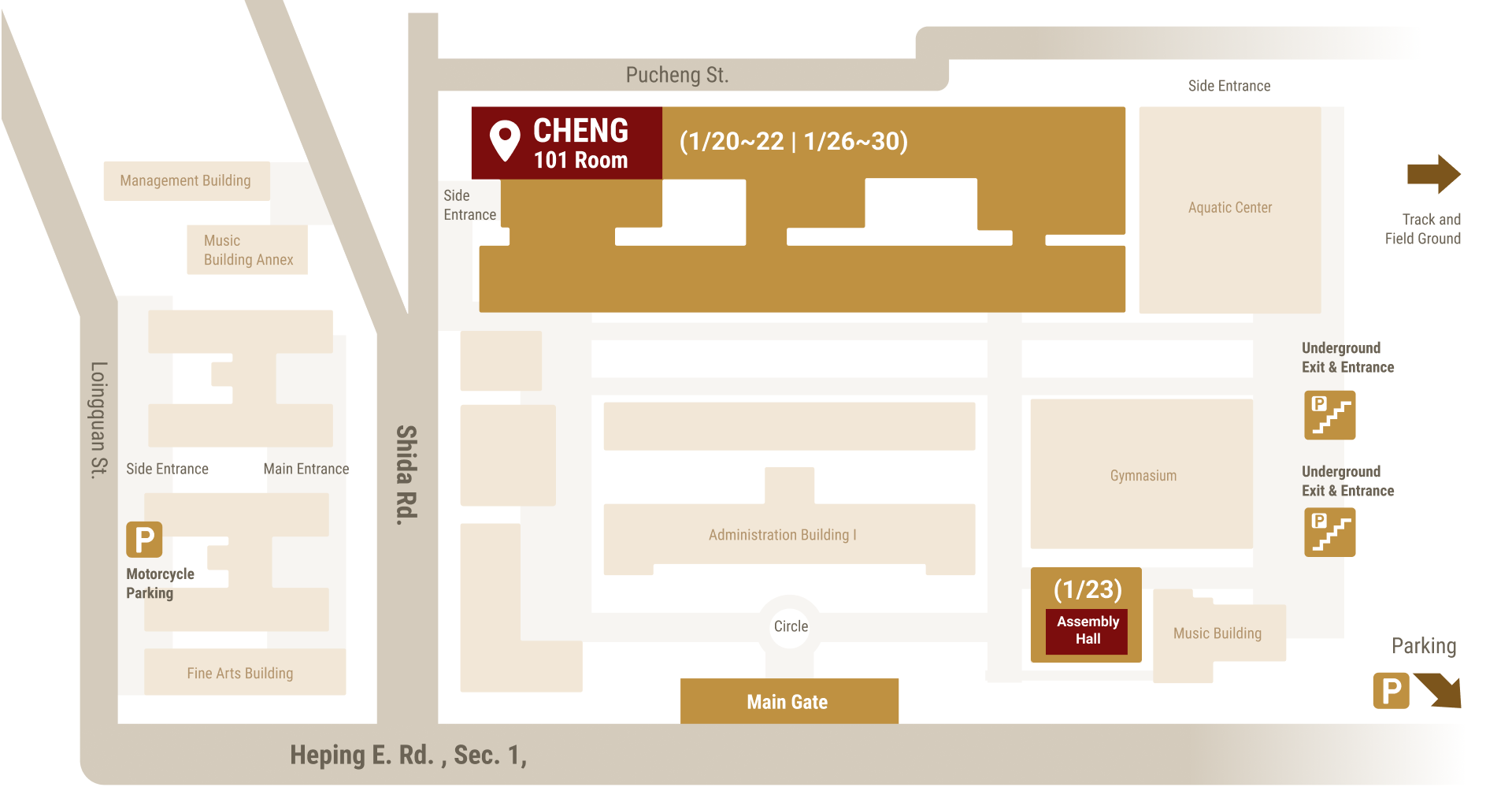
|
Registration deadline
All students, faculty, staff, and members of the public are required to complete registration through our official registration page.
The original registration deadline was 9:00 a.m., January 16, 2026. Due to strong demand and limited capacity, registration will close at 1:00 p.m. (Taiwan Time), January 12, 2026.
OTHERS | Other Frequently Asked Questions
Is there any course fee?
Most participants may join the program free of charge. Fee details are as follows:
Students from the NTU System (NTNU, NTU, NTUST): Free of charge.
Members of the general public who do not require academic credits: Free of charge.
Students from other universities and members of the public who wish to earn credits:
During February 9–March 9, 2026, please follow the official procedures and submit a paper-based
application to the Office of Academic Affairs and pay the required credit fees.
For detailed instructions, please refer to the NTNU Academic Affairs website:
https://www.aa.ntnu.edu.tw/zh_tw/selectives/Dayschool
Is the course fully taught in English? Do I need a certain level of English proficiency?
Yes, this course is fully taught in English. All lectures and discussions will be conducted in English by international professors from the UK and Japan. Students are advised to have basic English listening and reading ability for effective learning.
If I don’t need credits, can I still receive a certificate?
Yes. As long as you register and attend at least two-thirds of the total course hours, we will issue a bilingual certificate of completion even if you are not taking the course for credit.
How much attendance is required to receive the certificate?
You must attend at least two-thirds of the total course hours. Attendance will be recorded daily, so please attend as many sessions as possible.
How is housing arranged during the winter course period?
NTNU students who require accommodation must indicate their request in the registration form.(Click here to register)
A dedicated housing arrangement for this program is available as follows:
Stay period: January 19–30
Fees (including utilities and check-out cleaning):
Quad room: NTD 2,800
Triple room: NTD 3,400
Bed spaces will be allocated based on the order of application. Once availability is confirmed, students
will be notified with payment details and further instructions.
Students from other universities and members of the public must arrange their own accommodation.
Is there a limit on the number of seats?
Yes. This course has limited seats. To maintain instructional quality and interaction, we recommend registering as early as possible.
I study in graduate program, may I join?
Absolutely! This course is an international lecture series. Undergraduate students may earn general education credit, while graduate students are welcome to attend sessions based on interest. It is a rare opportunity to learn directly from international sustainability scholars.
How will the course be evaluated? Is the exam difficult?
Course Evaluation is as follows:
- Attendance and participation (60%): total of 15 sessions / 30 hours; each absence deducts 4%.
- Written exam (40%): held on the last day of class, January 30 2026.
This course emphasizes interdisciplinary thinking. As long as you attend lectures and participate seriously, the exam will not be difficult.
I do not have related background (e.g., design or forestry). Can I still take this course?
Yes. This is a general education lecture course, and the prerequisite requirement is “N/A.” The course aims to cultivate interdisciplinary sustainability thinking, and students from all majors are welcome to join.
Will graduate students receive credit for taking this General Education course?
If you are an NTNU graduate student and you complete the final assessment, the credit and grade will be recorded on your transcript as “additional credits,” but they will not count toward your graduation requirements. Graduate students from other universities should consult their own registrar’s office or academic department for confirmation.